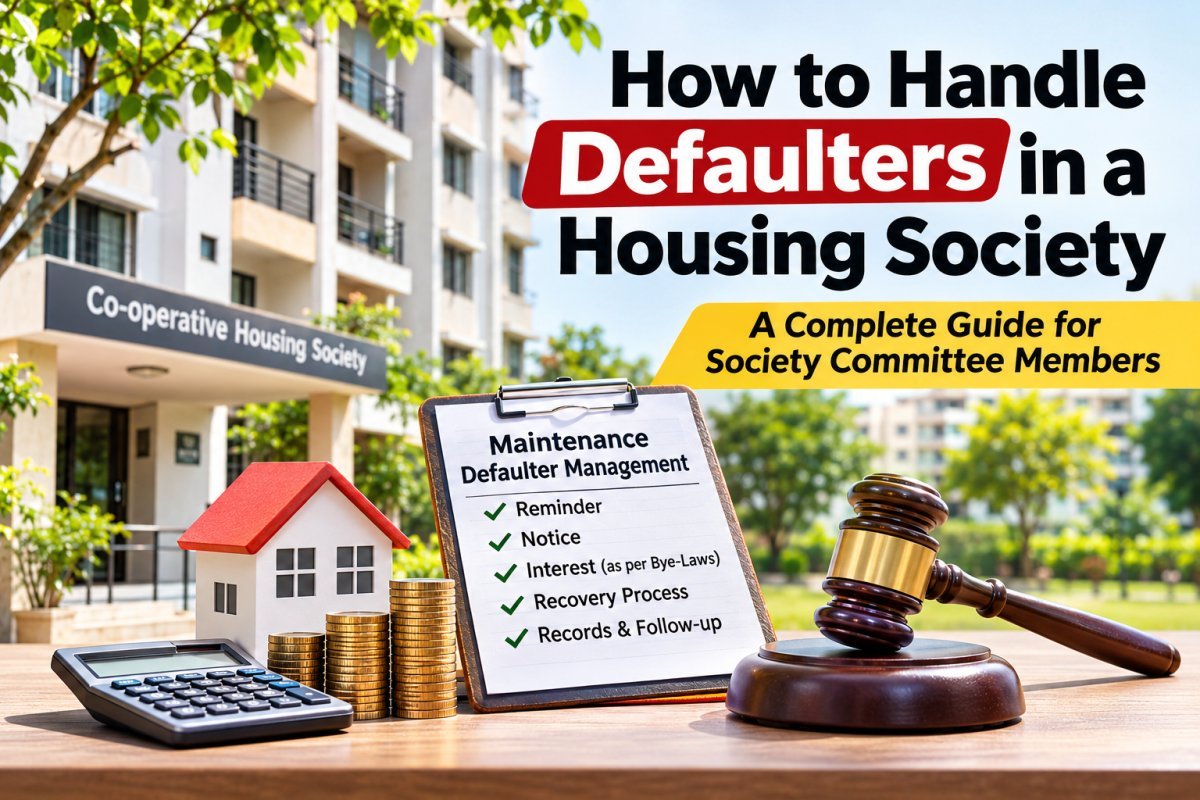
Managing a housing society requires proper financial planning and timely collection of monthly maintenance charges. One of the most common challenges faced by cooperative housing societies is maintenance payment default.
When some members fail to pay their maintenance charges on time, it can directly affect the society's ability to pay electricity bills, water charges, security agency expenses, housekeeping salaries, lift maintenance, repairs, and other essential services. Therefore, every housing society should implement a clear, transparent, and legally sound process for dealing with defaulters.
What Is a Housing Society Defaulter?
A housing society member who fails to pay maintenance charges or other legitimate society dues within the prescribed due date may be treated as a defaulter, subject to the society's applicable bye-laws and relevant state cooperative laws (such as the Maharashtra Co-operative Societies Act).
Outstanding society dues typically include:
- Monthly maintenance charges & service charges
- Water and electricity common charges
- Sinking fund and major repair fund contributions
- Parking charges (two-wheeler / four-wheeler)
- Non-occupancy charges (if flat is rented out)
- Applicable interest or late payment surcharges approved by AGM
Under Model Bye-law No. 56(a), a member who fails to clear society dues within 3 months of the due date is classified as a defaulter and loses the right to contest elections or vote in general body meetings until dues are fully cleared.
Why Do Members Become Defaulters?
Before taking stringent legal action, the Managing Committee should understand the root cause of non-payment. Common reasons include:
- Temporary Financial Difficulties: Sudden medical expenses, job transition, or business downtime.
- Forgot the Due Date: Out of town, busy schedule, or mislaid physical bill paper.
- Disputes Regarding Billing: Objections regarding non-occupancy charges, terrace leakage adjustment, or parking allocation.
- Incorrect Billing / Lack of Record: Payment made earlier via NEFT/UPI but receipt was not issued or updated in ledger.
- Communication Gap: Change of registered phone number or email without notifying society office.
- Personal Friction: Unresolved complaints against managing committee members.
8-Step Process to Recover Maintenance Legally & Professionally
Step 1: Maintain Accurate Billing Records
The first defense against default disputes is 100% accurate accounting. Before contacting a member, verify the member's ledger:
- Verify previous opening balance and payments received with bank reconciliation.
- Check whether late payment interest rate complies with bye-law limits (maximum simple interest up to 21% p.a.).
- Ensure all approved credits, discounts, or prior adjustments are reflected.
Step 2: Send a Friendly Payment Reminder
Initial communication should always be polite and non-confrontational. Send automated reminders via WhatsApp, SMS, Email, or society app:
Sample Friendly Reminder Message:
"Dear Member (Flat No. ___),
This is a gentle reminder that an amount of ₹_______ is outstanding against your flat towards monthly society maintenance and common utility dues. Kindly clear the outstanding balance by [Due Date] to avoid applicable interest charges.
You can pay online via UPI / NetBanking and upload the transaction screenshot here: [Society Payment Link].
Thank you for your cooperation.
Managing Committee, [Society Name]"
Step 3: Provide a Detailed Statement of Account
If a member expresses doubt or claims they paid earlier, do not argue orally. Immediately provide an itemized Statement of Account:
| Particulars | Amount (₹) |
|---|---|
| Previous Balance / Arrears | ₹ 12,500.00 |
| Current Month Maintenance | ₹ 3,200.00 |
| Sinking Fund & Major Repairs | ₹ 800.00 |
| Simple Interest @ 21% p.a. | ₹ 656.00 |
| Less: Payments Received / Credits | - ₹ 0.00 |
| Total Net Outstanding Dues | ₹ 17,156.00 |
Step 4: Give a Formal Written Notice
When informal reminders go unanswered for over 60–90 days, issue a formal written notice as per the society bye-laws:
- Send via Registered Post A.D. or Speed Post (and also via official email / WhatsApp).
- Provide a clear 15 to 21-day timeline to clear the dues or submit written representation.
- Keep the postal tracking receipt and delivery confirmation permanently in the society register.
Step 5: Allow the Member to Raise Genuine Objections
Every member is entitled to principles of natural justice. Invite the member to the committee meeting. If an error is spotted in past calculations, pass a committee resolution and rectify it immediately.
Step 6: Apply Interest Strictly as per Bye-laws
Never levy arbitrary penalty charges that are not approved in the AGM or not permissible under the state cooperative act. Interest must only be simple interest (not compound interest) up to the limit sanctioned by the general body (normally up to 21% p.a.).
Step 7: Maintain a Defaulter Register & Audit Trail
Document each stage:
- Exact date and dispatch number of every notice sent.
- Acknowledgement receipts signed by the member.
- Committee meeting minutes recording the defaulter discussion.
Step 8: Initiate Legal Recovery (Under Section 154B-29 / Section 101 of MCS Act)
If all notices and opportunities fail, the society can proceed with statutory recovery without filing long civil court lawsuits:
Summary Recovery Under Section 154B-29 (Maharashtra):
The Managing Committee passes a resolution to file an application before the Deputy Registrar of Co-operative Societies for a Recovery Certificate under Section 154B-29 of the Maharashtra Co-operative Societies Act. Once the Registrar issues the certificate, the Recovery Officer is empowered to attach bank accounts or movable/immovable assets of the defaulter to satisfy society maintenance dues.
⚠️ What Managing Committees Must NEVER Do
- Do NOT disconnect essential supplies: Never disconnect electricity, domestic water supply, or lift usage. High Courts have repeatedly held that water and electricity are fundamental rights under Article 21. Disconnecting them can lead to police complaints and injunctions against committee members.
- Do NOT publicly humiliate: Do not stick derogatory posters on the member's main door or post abusive messages on social media groups.
- Do NOT stop visitors or domestic staff: Barring housemaids, couriers, or medical attendants is unlawful restraint under IPC.
- Do NOT impose unauthorized fines: Fines not sanctioned by model bye-laws or without general body approval will be quashed by the Co-operative Court.
How Society Mitra Simplifies Defaulter Management
Traditional societies fail at defaulter recovery because of lost paper bills, unrecorded payments, and manual errors. Society Mitra digitizes the entire maintenance collection lifecycle:
Automated Billing
Generates monthly/quarterly bills on the 1st of every month with itemized heads.
Accurate Interest Engine
Calculates simple interest on overdue invoices automatically according to society rules.
WhatsApp & SMS Reminders
Sends instant bill PDFs and direct payment link to members on WhatsApp.
1-Click Defaulter Register
Download ready-to-file legal defaulter lists, age-wise aging reports, and ledger statements in seconds.
Conclusion
Maintenance collection is the lifeline of every cooperative housing society. However, recovery should never lead to hostility or personal conflict. By combining transparent billing, polite reminders, accurate statements, and proper legal procedures, housing societies can maintain a 98%+ collection efficiency while fostering goodwill among all residents.