Housing Society Parking Rights & Allotment Rules
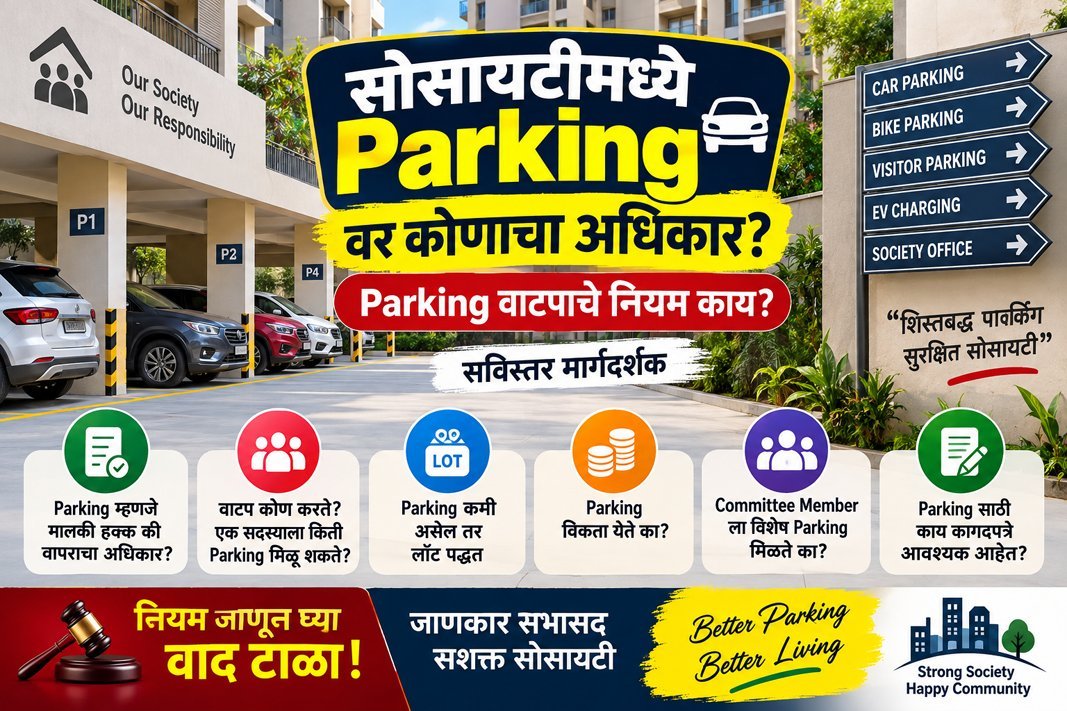
Parking is one of the most common reasons for disputes in a Housing Society. Who gets a parking space? How many parking spaces can one member get? Can a parking space be sold or transferred? What happens when the number of parking spaces is less than the number of members who own vehicles?
This article explains the important aspects of Housing Society Parking Rights, Parking Allotment and Parking Rules in a simple and practical way.
🚗 1. Is Parking a Property Right or a Right to Use?
One of the biggest misconceptions in housing societies is that a parking space automatically becomes the personal property of a flat owner.
If a parking space is allotted by the society to a member, the allotment generally gives the member the right to use that space according to the applicable rules. It should not automatically be treated as an independent ownership right over that parking space.
Therefore, there is an important difference between:
- Parking allotted for use
- Independent ownership of a parking space
Members should therefore check the relevant documents and applicable bye-laws before claiming ownership over a parking space.
🏢 2. Who Allots Parking in a Housing Society?
The Managing Committee is responsible for managing the parking arrangements of the society and carrying out parking allotment according to the applicable rules.
However, the committee should not allot parking spaces arbitrarily. The allotment process should be transparent and consistent with the society's registered bye-laws and valid resolutions.
🚘 3. How Many Parking Spaces Can One Member Get?
The number of parking spaces available, the number of members and the number of vehicle-owning members can affect the allotment process.
Generally, eligible members are considered for parking according to the available parking spaces and the applicable society rules.
If additional parking spaces remain available after meeting the requirements of other eligible members, the society may deal with such spaces according to the applicable bye-laws.
📊 4. What Happens When Parking Spaces Are Fewer Than Vehicle Owners?
This is one of the most common situations in housing societies.
| Particular | Number |
|---|---|
| Total Flats | 100 |
| Available Parking Spaces | 60 |
| Members with Vehicles | 85 |
In such a situation, it is not possible to provide a parking space to every vehicle owner.
Where the applicable bye-laws provide for it, parking may be allotted through a lottery or draw system when eligible applicants are more than the available parking spaces.
This is why a member cannot always claim that a parking space should remain permanently with them simply because they have been using it for many years.
💰 5. Can a Society-Allotted Parking Space Be Sold?
This is a very important question.
A parking space allotted by a housing society should not automatically be treated as an independently saleable property of the member.
Before attempting to sell, transfer or permanently hand over a parking space, the member should check the registered bye-laws, relevant agreements, society records and applicable legal provisions.
A member should not assume that a parking space can be sold simply because the member has been using it for several years.
👔 6. Does a Committee Member Get Special Parking Rights?
Simply being a Chairman, Secretary or Managing Committee Member does not automatically create a special right to obtain additional or permanent parking.
Parking allotment should be carried out according to the applicable rules and should be transparent and fair to eligible members.
💵 7. Can the Society Charge Parking Fees?
A housing society may charge parking fees according to its applicable bye-laws and valid decisions of the General Body.
The method of calculating the charges and the applicable rate should be properly recorded in the society's records.
Members should ask for the relevant resolution or rule if they have a question about parking charges.
📝 8. How Should a Member Apply for Parking?
A member who requires parking should submit a written application to the society office or Secretary.
The application may contain the following details:
- Full Name of the Member
- Flat Number
- Vehicle Type
- Vehicle Registration Number
- Vehicle Ownership Details
- Contact Number
- Other documents required by the society
Keeping the application in writing helps maintain transparency and creates an official record of the member's request.
📋 9. What Parking Records Should a Society Maintain?
Proper documentation is extremely important for avoiding parking disputes. A society should maintain appropriate records relating to parking allotment.
- Parking Allotment Register
- Parking Application Forms
- Parking Numbering Plan
- Managing Committee Resolutions
- General Body Resolutions
- Parking Charges Records
- Parking Allotment Details of Members
⚠️ 10. Seven Common Misconceptions About Society Parking
❌ Misconception 1 – “Parking automatically belongs to me with my flat.”
The legal status of the parking space should be checked separately. Parking arrangements can depend on the society's documents, bye-laws and applicable laws.
❌ Misconception 2 – “I have used this parking for 10 years, so it is permanently mine.”
Long-term use alone should not automatically be treated as proof of independent ownership.
❌ Misconception 3 – “Committee members are entitled to two parking spaces.”
Holding a committee position does not automatically give a member the right to additional parking.
❌ Misconception 4 – “I can sell my allotted parking to another person.”
Before transferring or selling any society-allotted parking space, the applicable bye-laws and legal documents must be checked.
❌ Misconception 5 – “Once parking is allotted, it can never be changed.”
Depending on the applicable rules and circumstances, parking allotments may be subject to re-allotment or other procedures.
❌ Misconception 6 – “I have two cars, so I automatically have the right to two parking spaces.”
Having more than one vehicle does not automatically guarantee multiple parking spaces. The number of available spaces and the applicable allotment rules must be considered.
❌ Misconception 7 – “The Managing Committee can decide anything about parking.”
The Managing Committee must act within the framework of applicable laws, registered bye-laws and valid General Body decisions.
📂 11. What Documents Should a Member Ask for in a Parking Dispute?
If a member has a question or dispute regarding parking allotment, the member can submit a written request to the society asking for relevant records, subject to applicable law and access rules.
- Parking Policy / Parking Rules
- Registered Bye-Laws
- Parking Allotment Register
- Parking Application Forms
- Managing Committee Resolution
- General Body Resolution
- Resolution relating to Parking Charges
- Parking Plan / Numbering Plan
- Record of Parking Allotted to the Member
⚖️ 12. What Should a Member Do If There Is a Parking Dispute?
The first step should normally be to submit a written complaint or representation to the Chairman, Secretary or Managing Committee.
Instead of relying only on verbal discussions, members should maintain written correspondence and preserve copies of applications, replies and relevant documents.
If the issue is not resolved, the member can consider approaching the appropriate cooperative authority or other competent legal forum depending on the nature of the dispute.
✅ Key Takeaway
Parking is not simply a matter of “whoever used it first owns it permanently.” Parking arrangements should be determined based on the available spaces, eligible members, registered bye-laws, applicable laws and valid decisions of the society.
📌 10 Important Points Every Society Member Should Know
- Parking and flat ownership are separate matters.
- Parking allotment should be properly recorded.
- The parking allotment process should be transparent.
- Eligible members should be treated according to the applicable rules.
- Rules for additional parking should be clearly defined.
- Parking charges should be properly recorded.
- Managing Committee resolutions should be preserved.
- Relevant General Body resolutions should be maintained.
- Parking disputes should preferably be raised in writing.
- The society's registered bye-laws and documents should be checked in every specific case.
🏠 Final Question: Who Has the Right Over a Parking Space?
There is no single answer that applies to every housing society. The actual position depends on the society's structure, available parking spaces, number of eligible members, registered bye-laws, relevant agreements and the parking allotment records maintained by the society.
Therefore, instead of simply asking: “Whose parking is this?”
A better question is: “What is the rule and what is the official record under which this parking space has been allotted?”
This article is intended for general information and awareness only. Parking rights and allotment can depend on the registered bye-laws, agreements, society resolutions, building documents and applicable laws. For a specific dispute or legal matter, the relevant documents should be examined and appropriate professional legal advice may be obtained.